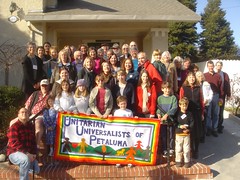
Unitarian Universalists of Petaluma

The purpose of this congregation is to provide a haven where members can share in a spiritually, culturally, and socially diverse local religious community. We envision a congregation that will be welcoming to all, that values the contributions of each member in shared ministry, and that actively promotes and models individual development of an ethical way of living. We are intentionally intergenerational, and covenant to provide religious education and spiritual growth for children and adults.

Tuesday, July 10, 2007

"Every Night and Every Morn": Hymn of the Month for July 2007


Words: William Blake (1757-1827)


Music: Ralph Vaughan Williams (1872-1958)


That about says it all. Blake & Vaughan Williams! What a great one-two punch.

From Between the Lines:

[Blake] was a visionary British poet and painter who wrote and illustrated epic poems on religious and mystical themes. His well-known works include The Marriage of Heaven and Hell and Songs of Innocence. This text is arranged from Auguries of Innocence.

[Vaughan Williams's] genius and enthusiasm for folk song brought new life to British hymnody and music. A native of Gloucestershire, Vaughan Williams studied at the Royal College of Music and at Trinity College, Cambridge, where he received a doctorate of music in 1901. Among his teachers were Sir Hubert Parry and Maurice Ravel. His compositions include many choral works and songs, four operas, nine symphonies, and numerous hymns.

Here is the full text of Auguries of Innocence:

To see a World in a Grain of Sand
And a Heaven in a Wild Flower,
Hold Infinity in the palm of your hand
And Eternity in an hour.

A Robin Red breast in a Cage
Puts all Heaven in a Rage.
A dove house fill'd with doves & Pigeons
Shudders Hell thro' all its regions.
A dog starv'd at his Master's Gate
Predicts the ruin of the State.
A Horse misus'd upon the Road
Calls to Heaven for Human blood.
Each outcry of the hunted Hare
A fibre from the Brain does tear.
A Skylark wounded in the wing,
A Cherubim does cease to sing.
The Game Cock clipp'd and arm'd for fight
Does the Rising Sun affright.
Every Wolf's & Lion's howl
Raises from Hell a Human Soul.
The wild deer, wand'ring here & there,
Keeps the Human Soul from Care.
The Lamb misus'd breeds public strife
And yet forgives the Butcher's Knife.
The Bat that flits at close of Eve
Has left the Brain that won't believe.
The Owl that calls upon the Night
Speaks the Unbeliever's fright.
He who shall hurt the little Wren
Shall never be belov'd by Men.
He who the Ox to wrath has mov'd
Shall never be by Woman lov'd.
The wanton Boy that kills the Fly
Shall feel the Spider's enmity.
He who torments the Chafer's sprite
Weaves a Bower in endless Night.
The Catterpillar on the Leaf
Repeats to thee thy Mother's grief.
Kill not the Moth nor Butterfly,
For the Last Judgement draweth nigh.
He who shall train the Horse to War
Shall never pass the Polar Bar.
The Beggar's Dog & Widow's Cat,
Feed them & thou wilt grow fat.
The Gnat that sings his Summer's song
Poison gets from Slander's tongue.
The poison of the Snake & Newt
Is the sweat of Envy's Foot.
The poison of the Honey Bee
Is the Artist's Jealousy.
The Prince's Robes & Beggars' Rags
Are Toadstools on the Miser's Bags.
A truth that's told with bad intent
Beats all the Lies you can invent.
It is right it should be so;
Man was made for Joy & Woe;
And when this we rightly know
Thro' the World we safely go.
Joy & Woe are woven fine,
A Clothing for the Soul divine;
Under every grief & pine
Runs a joy with silken twine.
The Babe is more than swadling Bands;
Throughout all these Human Lands
Tools were made, & born were hands,
Every Farmer Understands.
Every Tear from Every Eye
Becomes a Babe in Eternity.
This is caught by Females bright
And return'd to its own delight.
The Bleat, the Bark, Bellow & Roar
Are Waves that Beat on Heaven's Shore.
The Babe that weeps the Rod beneath
Writes Revenge in realms of death.
The Beggar's Rags, fluttering in Air,
Does to Rags the Heavens tear.
The Soldier arm'd with Sword & Gun,
Palsied strikes the Summer's Sun.
The poor Man's Farthing is worth more
Than all the Gold on Afric's Shore.
One Mite wrung from the Labrer's hands
Shall buy & sell the Miser's lands:
Or, if protected from on high,
Does that whole Nation sell & buy.
He who mocks the Infant's Faith
Shall be mock'd in Age & Death.
He who shall teach the Child to Doubt
The rotting Grave shall ne'er get out.
He who respects the Infant's faith
Triumph's over Hell & Death.
The Child's Toys & the Old Man's Reasons
Are the Fruits of the Two seasons.
The Questioner, who sits so sly,
Shall never know how to Reply.
He who replies to words of Doubt
Doth put the Light of Knowledge out.
The Strongest Poison ever known
Came from Caesar's Laurel Crown.
Nought can deform the Human Race
Like the Armour's iron brace.
When Gold & Gems adorn the Plow
To peaceful Arts shall Envy Bow.
A Riddle or the Cricket's Cry
Is to Doubt a fit Reply.
The Emmet's Inch & Eagle's Mile
Make Lame Philosophy to smile.
He who Doubts from what he sees
Will ne'er believe, do what you Please.
If the Sun & Moon should doubt
They'd immediately Go out.
To be in a Passion you Good may do,
But no Good if a Passion is in you.
The Whore & Gambler, by the State
Licenc'd, build that Nation's Fate.
The Harlot's cry from Street to Street
Shall weave Old England's winding Sheet.
The Winner's Shout, the Loser's Curse,
Dance before dead England's Hearse.
Every Night & every Morn
Some to Misery are Born.
Every Morn & every Night
Some are Born to sweet Delight.
Some are Born to sweet Delight,
Some are born to Endless Night.
We are led to Believe a Lie
When we see not Thro' the Eye
Which was Born in a Night to Perish in a Night
When the Soul Slept in Beams of Light.
God Appears & God is Light
To those poor Souls who dwell in the Night,
But does a Human Form Display
To those who Dwell in Realms of day.

Labels: ,

Wednesday, June 13, 2007

"Bring Many Names": Hymn of the Month for June 2007

Hymn # 23, "Bring Many Names," is an innovative piece of writing on a big topic--the name of God. Its theology resonates with many UUs, who see the divine in all, and who recognize "the inherent worth and dignity of every person."
From "Between the Lines:

"Brian Wren (1936- ), a contemporary hymn writer, was born and educated in England. Ordained a minister in the United Reformed Church, he served local congregations, served on the staff of the British Council of Churches, and worked for Third World First prior to 1983, when he chose to devote himself full-time to hymn writing. He is the author of Education for Justice, What Language Shall I Borrow?, and several hymn collections.

The tune, "Westchase," is by Carlton R. Young, who is the editor of the 1989 and 1966 Methodist Hymnals.

Labels:

Saturday, May 19, 2007

"How Can I Keep From Singing?"--Hymn of the Month, May 2007

UUP's Hymn of the Month for May is "How Can I Keep From Singing." However, you won't find it listed under that title in our hymnal, because of the lack of a title index. Instead, the hymn is called by its first line: "My Life Flows On In Endless Song." It is Hymn Number 108.

An old hymn, originally published in 1860, with words by Robert Lowry, and music by Ira D. Sankey, it was given a new lease on life in the McCarthy era by Doris Plenn, who wrote a new third verse to honor those who refused to sign loyalty oaths, and were, therefore, often punished.

When tyrants tremble, sick with fear,
And hear their death-knell ringing,
When friends rejoice both far and near,
How can I keep from singing?
In prison cell and dungeon vile
Our thoughts to them are winging.
When friends by shame are undefiled,
How can I keep from singing?


"How Can I Keep From Singing?" is the title of Pete Seeger's biography, by David Kay Dunaway.

Labels:

Sunday, April 08, 2007

"Wake, Now, My Senses"--Hymn of the Month, April 2007

This month's hymn is "Wake, Now, My Senses," with words by Thomas J.S. Mikelson (1936-), and a traditional Irish tune, harmozied by Carlton R. Young. According to Between the Lines:

Mikelson, born in Iowa, is a Unitarian Universalist minister. He has served congregations in Iowa City, Iowa, and Brookline and Dedham, Massachusetts, and is serving the First Parish Church in Cambridge, Massachusetts. This hymn was written for the ordination and installation of Charity Rowley as minister of religious education in the First Parish Church of Arlington, Massachusetts.

Mikelson retired in 2006 as minister of First Parish. He has written and lectured extensively about the theology of Martin Luther King, Jr., including an article in the UU World entitled "Martin Luther King Jr.'s Demanding God.

UUP sang this beautiful hymn at our Covenanting Sunday in October 2002.

Labels: ,

Wednesday, March 07, 2007

"We Sing Of Golden Mornings": Hymn of the Month for March, 2007


Our featured hymn this month is #44: "We Sing of Golden Mornings." The words are loosely based on a poem by Ralph Waldo Emerson, "The World Soul" (1847), as rewritten first by Walter Walsh, then recast by Vincent Silliman in 1955 for the UU hymnal We Sing of Life, and finally recast once again in 1990 for our current hymnal, thusly:

We sing of golden mornings, we sing of sparkling seas,
of prairies, valleys, mountains, and stately forest trees.
We sing of flashing sunshine and life-bestowing rain,
of birds among the branches, and springtime come again.

We sing the heart courageous, the youthful, eager mind;
we sing of hopes undaunted, of friendly ways and kind.
We sing the roses waiting beneath the deep-piled snows;
we sing the earth's great splendor, whose beauty around us glows.


The only line changed in the 1990 arrangement from Silliman's work was his closing line:

We sing, when night is darkest, the day's returning glow.


Emerson's original poem, for the record (via http://rwe.org) (I don't know...I don't really see the derivation. Am I blind?):

Thanks to the morning light,
Thanks to the seething sea,
To the uplands of New Hampshire,
To the green-haired forest free;
Thanks to each man of courage,
To the maids of holy mind,
To the boy with his games undaunted,
Who never looks behind.

Cities of proud hotels,
Houses of rich and great,
Vice nestles in your chambers,
Beneath your roofs of slate.
It cannot conquer folly,
Time-and-space-conquering steam,—
And the light-outspeeding telegraph
Bears nothing on its beam.

The politics are base,
The letters do not cheer,
And 'tis far in the deeps of history—
The voice that speaketh clear.
Trade and the streets ensnare us,
Our bodies are weak and worn,
We plot and corrupt each other,
And we despoil the unborn.

Yet there in the parlor sits
Some figure of noble guise,
Our angel in a stranger's form,
Or woman's pleading eyes;
Or only a flashing sunbeam
In at the window pane;
Or music pours on mortals
Its beautiful disdain.

The inevitable morning
Finds them who in cellars be,
And be sure the all-loving Nature
Will smile in a factory.
Yon ridge of purple landscape,
Yon sky between the walls,
Hold all the hidden wonders
In scanty intervals.

Alas, the sprite that haunts us
Deceives our rash desire,
It whispers of the glorious gods,
And leaves us in the mire:
We cannot learn the cipher
That's writ upon our cell,
Stars help us by a mystery
Which we could never spell.

If but one hero knew it,
The world would blush in flame,
The sage, till he hit the secret,
Would hang his head for shame.
But our brothers have not read it,
Not one has found the key,
And henceforth we are comforted,
We are but such as they.

Still, still the secret presses,
The nearing clouds draw down,
The crimson morning flames into
The fopperies of the town.
Within, without, the idle earth
Stars weave eternal rings,

The sun himself shines heartily,
And shares the joy he brings.

And what if trade sow cities
Like shells along the shore,
And thatch with towns the prairie broad
With railways ironed o'er;—
They are but sailing foambells
Along Thought's causing stream,
And take their shape and Sun-color
From him that sends the dream.

For destiny does not like
To yield to men the helm,
And shoots his thought by hidden nerves
Throughout the solid realm.
The patient Dæmon sits
With roses and a shroud,
He has his way, and deals his gifts—
But ours is not allowed.

He is no churl or trifler,
And his viceroy is none,
Love-without-weakness,
Of genius sire and son;

And his will is not thwarted,—
The seeds of land and sea
Are the atoms of his body bright,
And his behest obey.

He serveth the servant,
The brave he loves amain,
He kills the cripple and the sick,
And straight begins again;
For gods delight in gods,
And thrust the weak aside;
To him who scorns their charities,
Their arms fly open wide.

When the old world is sterile,
And the ages are effete,
He will from wrecks and sediment
The fairer world complete.
He forbids to despair,
His cheeks mantle with mirth,
And the unimagined good of men
Is yeaning at the birth.

Spring still makes spring in the mind,
When sixty years are told;

Love wakes anew this throbbing heart,
And we are never old.
Over the winter glaciers,
I see the summer glow,
And through the wild-piled snowdrift
The warm rose buds below.


In his essay about our hymnals delivered at General Assembly in 1977, Silliman writes:

“We sing of golden mornings” is another hymn of complex history. While We Sing [of Life] was in preparation, Edwin H. Wilson, Unitarian minister and Humanist leader, wrote that he could send me a batch of material he had collected through the years in which I might find things of use, if only I would do all the sorting out. The pile was nearly a foot high. In it was a tiny hymnbook of English origin, compiled in 1925, called Free Religious Hymns. I thought one text in it had possibilities; although it was mostly doggerel, it had some bright phrases. It was attributed to “Emerson.” It didn’t sound like Ralph Waldo Emerson to me; I didn’t trouble to look it up in Emerson; but I did shape a hymn text from it. The tune to which we sing it was chosen by Irving Lowens. After this hymn was accepted for Hymns for the Celebration [of Life], I thought I’d better check that Emerson attribution. Then I discovered that the text I had worked with was indeed based on Emerson. I trust that my rewrite still constitutes a better hymn.


The hymn's tune is attributed to William Walker's Southern Harmony, dating from 1835, and is entitled, quite wonderfully, "Complainer." Hmmmm. Wonder what that's about? Here's the original lyric:

I am a great complainer, that bears the name of Christ;
Come, all ye Zion mourners, and listen to my cries:
I've many sore temptations, and sorrows to my soul;
I feel my faith declining, and my affections cold.

O Lord of life and glory, my sins to me reveal,
And by thy love and power, my sin sick soul be healed;
I thought my warfare over, no trouble I should see;
But now I'm like the lonely dove, that mourns on the wavering tree.

I wish it was with me now, as in the days of old,
When the glorious light of Jesus was flowing in my soul;
But now I am distressed, and no relief can find,
With a hard deceitful heart, and a wretched wandering mind.

It is great pride and passion, beset me on my way,
So I am filled with folly, and so neglect to pray;
While others run rejoicing, and seem to lose no time,
I am so weak I stumble, and so I'm left behind.

I read that peace and happiness meet Christians in their way,
That bear their cross with meekness, and don't neglect to pray
But I, a thousand objects beset me in my way
So I am filled with folly, and so neglect to pray.

Labels: ,

Saturday, February 03, 2007

Hymn of the Month, February 2007: "Joy, Thou Goddess"


Beehoven's Ninth Symphony. Is there a more familiar piece of classical music? Do the children in every congregation gather around the piano after the service to show that they can play this melody? They do at UUP!

This month, our Hymn of the Month is "Joy, Thou Goddess" (#327). The words are by Friedrich Schiller (1759-1805) and the music is, of course, by Ludwig van Beehoven (1770-1827).

Schiller's Ode, entitled "An Die Freude" (To Joy) in German, is a milestone of optimism, celebrating the potential of humanity to shed its pre-Enlightenment ways and proceed into a brighter future, despite the "fashions" of the day, embracing the ideals of universal brotherhood. Here's the complete text (note that the German words are included in the hymanl--we may try them later in the month...)

Joy, thou glorious spark of heaven,
Daughter of Elysium,
We approach fire-drunk,
Heavenly One, your shrine.
Your magic reunites
What custom strictly parts;
All people become brothers,
Where your gentle wing alights.

Chorus
Be embraced, you millions!
This kiss for the whole world!
Brothers, beyond the star-canopy
Must a loving Father dwell.
Do you bow down, you millions?
Do you sense the Creator, world?
Seek Him beyond the star-canopy!
Beyond the stars must He dwell.

Whoever succeeds in the great attempt
To be a friend of a friend,
Whoever has won a lovely woman,
Let him add his jubilation!
Yes, whoever calls even one soul
His own on the earth's globe!
And who never has, let him steal,
Weeping, away from this group.
All creatures drink joy
At the breasts of nature;
All the good, all the evil
Follow her roses' trail.
Kisses gave she us, and wine,
A friend, proven unto death;
Pleasure was to the worm granted,
And the cherub stands before God.
Glad, as his suns fly
Through the Heavens' glorious plan,
Run, brothers, your race,
Joyful, as a hero to victory.
Be embraced, you millions!
This kiss for the whole world!
Brothers, beyond the star-canopy
Must a loving Father dwell.
Do you bow down, you millions?
Do you sense the Creator, world?
Seek Him beyond the star-canopy!
Beyond the stars must He dwell.

Finale repeats the words:
Be embraced, ye millions!
This kiss for the whole world!
Brothers, beyond the star-canopy
Must a loving Father dwell.
Be embraced,
This kiss for the whole world!
Joy, beautiful spark of the gods,
Daughter of Elysium,
Joy, beautiful spark of the gods


These are the words as set by Beehoven for his Symphony Number 9, considered by many to be the crowning achievement of his composing career, including, as it does, four soloists and a full choir and a final movement that can make the hair on your arms stand straight up.

Let's see how well we can do, and have some fun!

Labels: ,

Thursday, January 04, 2007

We'll Build a Land: Hymn of the Month for January 2007

Our hymn of the month for January is "We'll Build a Land" (#121). According to Between the Lines: "These words from Isaiah and Amos were adpated by Barbara Zanotti (20th century), a peace activist now living in Maine."


Amos 5:24 was famously cited by Martin Luther King, Jr: "Justice shall roll down like waters, righteousness like a mighty stream." These are the words on the Civil Rights Memorial in Montgomery, Alabama, designed by Maya Lin, who was inspired by Dr. King's use of the phrase in his "I Have a Dream" speech. (Left)

The music is by Carolyn McDade, a UU songwriter and composer of one of our best-loved hymns, "Spirit of Life." She attends the Unitarian Universalist Community Church of Boston.

Labels: ,

Thursday, November 30, 2006

Hymn of the Month for December 2006


#296: "O Ye Who Taste That Love Is Sweet"

A favorite of our choir, Larking About, this lovely hymn has words by Christina Georgina Rossetti (1830-1894), and is set to a French melody from around 1500. According to Between the Lines:

This tune is probably the original melody for the text written by Jean Tisserand, a Franciscan monk, who died in Paris in 1494. The melody was first printed in Airs sur les hymnes sacrez, odes et noels, Paris, 1623.


Also from Between the Lines:

Christina Rossetti was an English poet, known for short, intense lyrics such as these [in reference to her words to our hymn #241, "In the Bleak Midwinter"]. She was the daughter of the exiled Italian patriot and writer Gabriele Rossetti, and the sister of Dante Gabriel Rossetti, poet and painter.

She was, with her brother, a member of the Pre-Raphaelite art movement in England.

The hymn's words are composed of the final three stanzas of Rossetti's poem, "What Good Shall My Life Do Me?"

No hope in life: yet is there hope
In death, the threshold of man's scope.
Man yearneth (as the heliotrop

For ever seeks the sun) through light,
Through dark, for Love: all, read aright,
Is Love, for Love is infinite.

Shall not this infinite Love suffice
To feed thy dearth? Lift heart and eyes
Up to the hills, grow glad and wise.

The hills are glad because the sun
Kisses their round tops every one
Where silver fountains laugh and run:

Smooth pebbles shine beneath : beside,
The grass, mere green, grows myriad-eyed
With pomp of blossoms veined or pied.

So every nest is glad whereon
The sun in tender strength has shone
So every fruit he glows upon:

So every valley depth, whose heards
At pasture praise him without words:
So the winged ecstasies of birds.

If there be any such thing, what
Is there by sunlight betters not?
Nothing except dead things that rot.

Thou then who are not dead, and fit,
Like blasted tree beside the pit,
But for the axe that levels it,

Living show life of Love, whereof
The force wields earth and heaven above:
Who knows not Love begetteth Love?

Love in the gracious rain distils :
Love moves the subtle fountain-rills
To fertilize uplifted hills,

And seedful valleys fertilize:
Love stills the hungry lion's cries,
And the young raven satisfies:

Love hangs this earth in space: Love rolls
Fair world rejoicing on their poles,
And girds them round with aureoles:

Love lights the sun: Love through the dark
Lights the moon's evanescent arc:
Same Love lights up the glow-worm's spark:

Love rears the great: Love tends the small:
Breaks off the yoke, breaks down the wall:
Accepteth all, fulfilleth all.

O ye who taste that Love is sweet,
Set waymarks for the doubtful feet
That stumble on in search of it.

Sing hyms of Love, that those who hear
Far off in pain may lend an ear,
Rise up and wonder and draw near.

Lead lives of Love, that others who
Behold your lives may kindle too
With love and cast their lots with you.

27 August 1859 - Christia Rossetti

Labels: ,

Monday, October 09, 2006

Hymn of the Month for October 2006

Two hymns in our hymnal, Singing the Living Tradition, are set to the beautiful tune by Jean Sibelius, "Finlandia." We are singing both of them as our "Hymn of the Month" for October, sort of a two-for-the-price-of-one situation.

The first is #318, "We Would Be One," with words by Samuel Anthony Wright. Rev. Wright is minister emeritus of the Unitarian Universalist Congregation of Marin--their downstairs big room is called the Wright Room. According to Between the Lines:

This text was written to accompany the tune "Sibelius" for Unitarian and Universalist youth at their Continental Convention of 1953-1954. At this conference they merged to form the Liberal Religious Youth of the United States and Canada, setting a model for the Unitarian Universalist denominational consolidation in 1961.

UUP member Jennine Lanouette has pointed out that our hymnal has changed the words that Wright originally wrote in the line:

"We would be one as now we join in singing our hymn of love..."

Wright's original line was sung as

"We would be one as now we join in singing our hymn of youth..."

...which makes perfect sense if you think of the occasion of Wright's penning these words being the uniting of two denominations' youth groups!

Hymn #159 is "This Is My Song," with words by Lloyd Stone, dating to 1934. It is a powerful statement for peace, and manages to express the strong emotions that lead to patriotic feelings and at the same time expand those feelings to include, via empathy, the entire planet. Immediately following the US invasion of Iraq in March 2004, UUP sang this song each week for weeks on end, as our prayer for peace, and our way of expressing the sorrow we felt.

About the tune by Sibelius, Between the Lines has this to say:

Jean Sibelius (1865-1957) was a dominant figure in the development of Finnish music. Born in Hameenlinna, Sibelius was greatly influenced by the Finnish national epic Kalevala, Norse mythology, and nature poetry. He began composing and playing the violin at an early age, and his music for orchestra achieved great popularity in Finland and abroad. This tune, composed as the chorale for his famous symphonic poem, Finlandia (1900), became strongly associated with the patriotic movement to free Finland from Russia.

Labels: ,

Wednesday, August 30, 2006

Hymn of the Month for September

Hymn #1 in our hymnal is "Prayer For This House," (entitled, in the hymnal, "May Nothing Evil Cross This Door," which is really just the first line....).

It's a beautiful hymn, with words by Louis Untermeyer (1885-1977), who, besides being an excellent poet, was an influential poetry anthologist in the early part of the 20th century, as well as a manufacturer of jewelry.

"Prayer For This House" is frequently used in house blessing rituals and building dedications, and its position as Number One is surely no accident. It's sort of a doorway into the whole hymnal.

The tune is by Robert N. Quaile, a Methodist minister's son from Mallow, Ireland. He composed the tune in 1903.

(I have always wondered if the founder of the Casual Corner clothing store chain got the name for the store from this song. Hmmmm.)

Labels: ,

Monday, July 31, 2006

"Hymn Of The Month"

This month: "Come, Come, Whoever You Are"

Last month, we began a new practice in our Sunday service, of singing a chosen hymn each Sunday for a month, as a way to truly learn the hymns, and increase the comfort level of singing in our small but enthusiastic congregation. Hymns are often a sore point on many scores, ranging from the sheer stodginess of some of the melodies, to the reminders they bring of the faith practices we have come out of, to the vestigial remnants of language and sensibilities to which we simply cannot relate.

In July, we (that is, Larking About, the UUP singers) chose "Be Ye Lamps Unto Yourselves," a hymn based upon the last words of the Buddha. That seemed to go pretty well.

In August, we have selected "Come, Come, Whoever You Are."

I am so proud to be able to say that I was around when this round was first sung as a round, at the First Unitarian Church of Oakland. Lynn Ungar, a fellow member of that congregation's Chancel Choir, set the (adapted) words of the Sufi poet, Rumi:

Come, come, whoever you are
Wanderer, worshiper, lover of leaving
Ours is no caravan of despair
Come, yet again, come

We all loved it immediately, and I got to be the person to write it out in musical notation (not to say that Lynn, an accomplished musician, couldn't have done it herself--I just felt like it and beat her to it).

Here's what the book Between the Lines: Sources for Singing the Living Tradition (Skinner House Books, 1998) has to say about the song, which has become hymn number 188:

"Jalal al-Din Rumi, Maulana (1207-1273), Sufi poet, was born in Afghanistan into a long line of scholars, jurists, and theologians. When he was thirty-seven he met a wandering holy man, Sham al-Din of Tabriz. With Shams he discovered the inner Friend, the soul, the Beloved, a constant reminder of Gold's presence. He subsequently wrote some 30,000 verses as well as the epic Masnavi-ye Ma'navi. This text has been adapted.
Lynn Ungar (1963- ) is a Unitarian Universalist minister... She is the author of the 1996 UUA Meditation Manual, Blessing the Bread.


Larking About will gladly accept nominations for future hymns of the month. September is currently under discussion!

Labels: ,